The Hand-Brain Loop: A Complete Framework for Hands-First Learning at Home

On Tuesday we introduced The Hand-Brain Loop — the continuous cycle of action, feedback, adjustment, and understanding that happens when a child works with physical materials toward a problem they genuinely want to solve. On Thursday we put it to work across three age bands, from sorting stones to flattening an orange peel. Today we bring the full week together.
This post answers three specific questions: What does the Hand-Brain Loop actually mean, and what does it get mistaken for? How did Fröbel design his sequence of Gifts and Occupations to move deliberately from concrete to abstract — and why does that sequence matter for your homeschool today? And what does a hands-first week actually look like across the age groups, in practice?
What Hands-First Learning Actually Is (And Isn’t)
The most common misreading of hands-first learning is that it means keeping things simple. That physical materials are for younger children. That as a child matures, the hands become less important and the mind takes over — blocks give way to books, building gives way to thinking, and the measure of progress is how quickly a child can work without needing to touch anything.
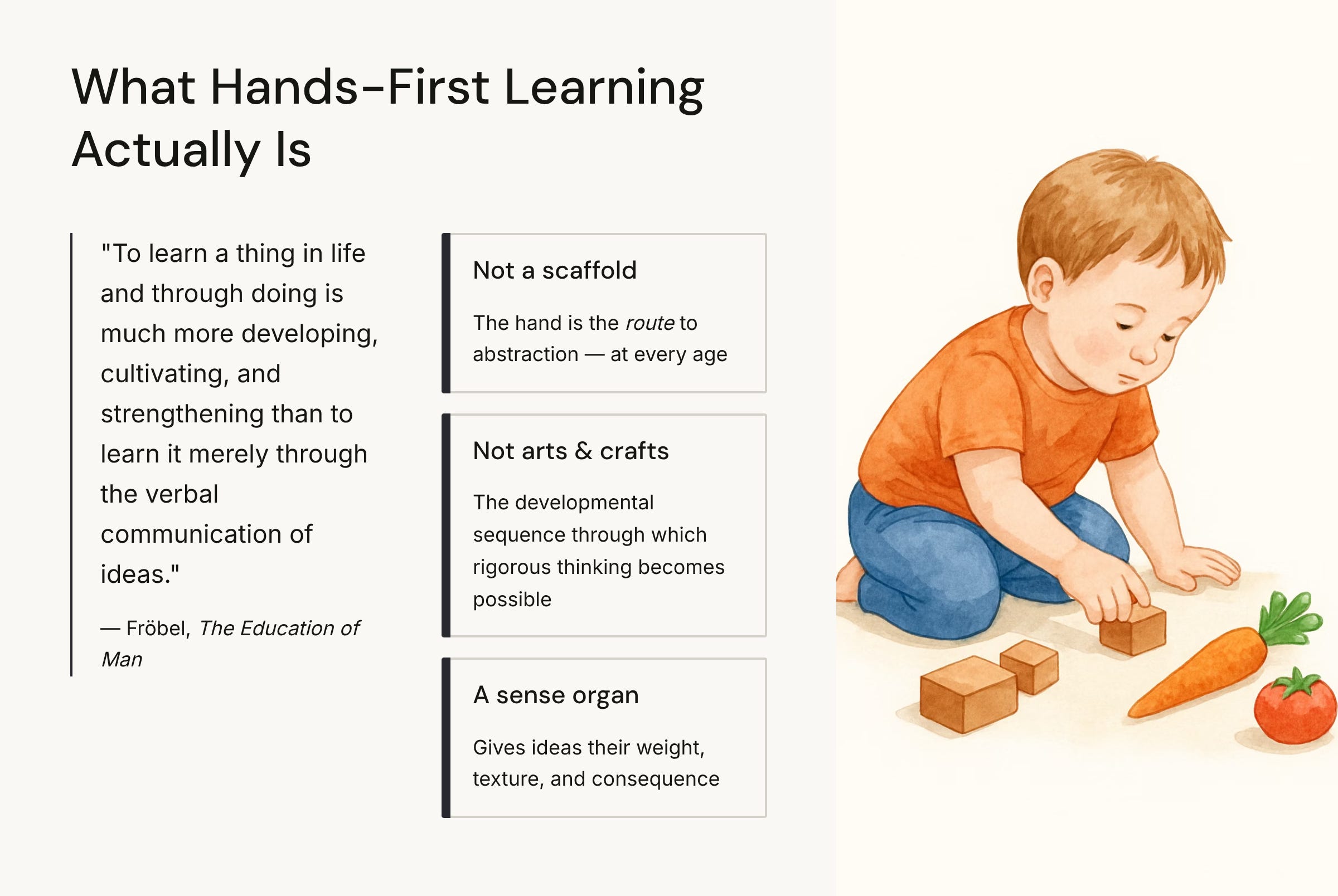
Fröbel’s position was the precise opposite. In The Education of Man he wrote: “To learn a thing in life and through doing is much more developing, cultivating, and strengthening than to learn it merely through the verbal communication of ideas.”
He was not making a case for early childhood only. He was making a case for the entire span of human learning. The hand is not a scaffold to be removed when the child is ready for abstraction. It is the route by which abstraction is reached — at every age, for every kind of concept.
Montessori arrived at the same conclusion through observation rather than philosophy. The story is worth knowing: visiting children in a Rome asylum early in her medical career, she noticed children grovelling on the floor after a meal. The caretaker saw greed. Montessori saw something else: these children, who had nothing in their environment to handle or explore, were not eating the crumbs. They were manipulating them with their fingers. The question she asked herself changed everything: what human need was this action fulfilling? Her eventual answer — that intelligence is built through the feedback loop between hand and brain, and that nothing should be given to the mind that has not first been given to the hand — became the foundation of every Montessori material ever designed.
What both Fröbel and Montessori understood, and what we keep forgetting, is this: the hand is not a delivery mechanism for what the brain has already decided. It is a sense organ — the one that gives ideas their weight, their texture, and their consequence.
Here is what The Hand-Brain Loop is not: it is not arts and crafts. It is not busy work. It is not an alternative to rigorous thinking for children who struggle with abstraction. It is the developmental sequence through which rigorous thinking becomes possible at all — for every child, at every level of complexity.
The kind of moment that makes this visible is one that practitioners describe again and again, across traditions and age groups. A child has been working for thirty minutes — sorting, building, folding, arranging. They haven’t asked for help. They haven’t looked up. Then something shifts. They sit back slightly. They look at what their hands have made. They nod — a small, private nod, barely visible — and reposition one piece with the careful precision of someone confirming something they already suspected. That nod is The Hand-Brain Loop completing its verification cycle. The hands have just told the brain something the brain didn’t know how to ask for.
The Named Framework: Fröbel’s Sequence from Solid to Symbol
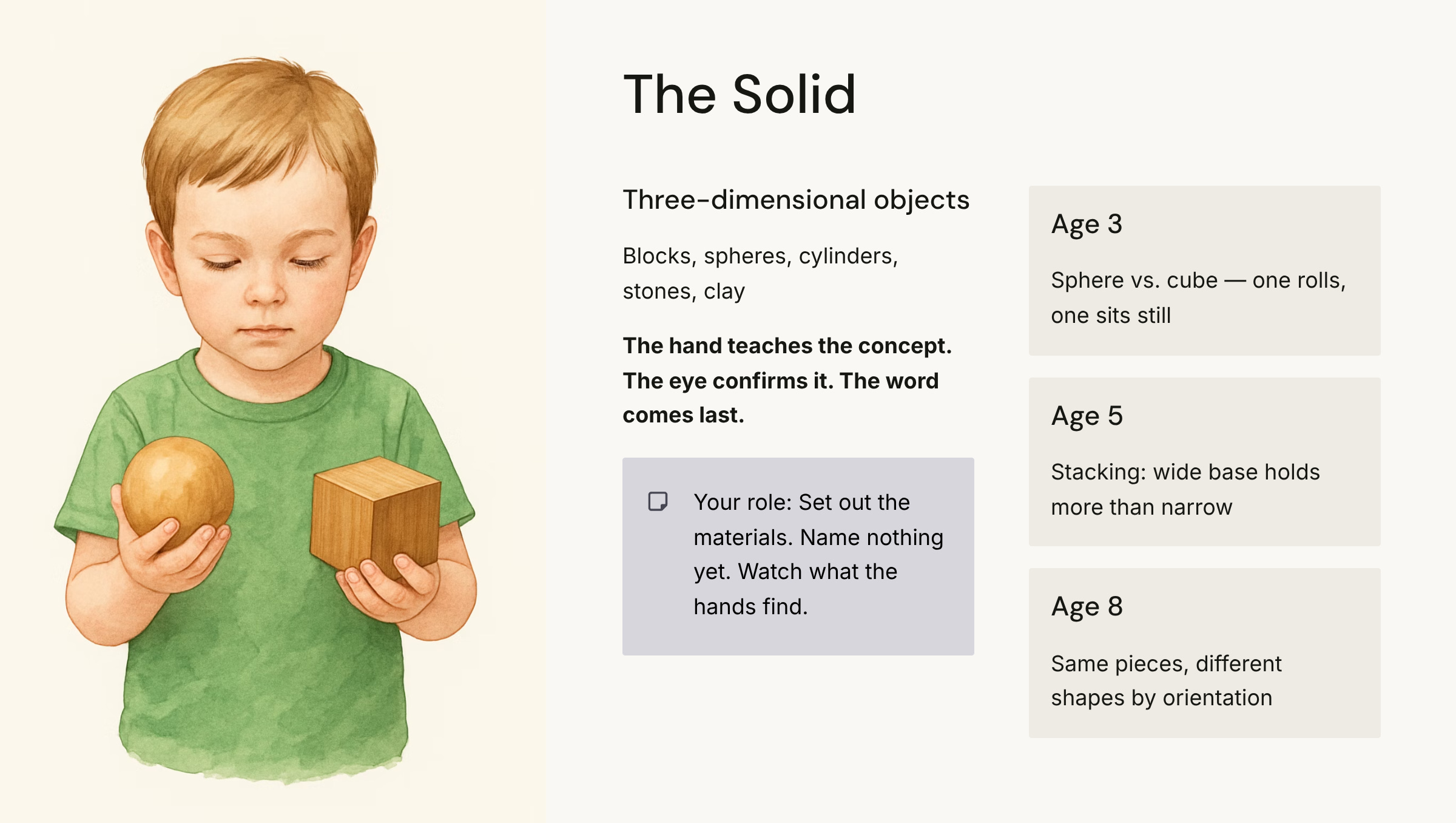
Fröbel’s entire sequence of Gifts and Occupations is built on a single developmental principle, stated plainly in Play is the Life of a Child: the child moves “from the spatial to the parts” — from the solid three-dimensional object through to the surface, the line, the point, and finally the abstract symbol.
I call this The Concrete-to-Abstract Ladder, and it is the architecture beneath everything in this week’s Thursday lesson and every lesson in this series.